
If you’ve ever wanted to start making art but felt too intimidated to try, you’re not alone. Maybe you’ve told yourself you’re not “good enough,” or that you don’t have the right supplies, or that you just don’t know where to begin. This post is a gentle reminder: you can start making art, right now, right where you are. Let’s talk about what really makes art “good,” how to begin, and how to practice in a way that’s kind to yourself.
What Is Good Art, Really?
Let’s get this out of the way: “good” art isn’t the same as “perfect” art. In fact, some of the most beloved art in the world is full of texture, bold decisions, and visible brushstrokes. It might not be realistic – but it’s real. Good art tells a story. It stirs something. It connects. Whether it’s messy, strange, sweet, or simple – it’s good if it made someone feel something. Even if that someone is just you. So if you’re waiting until you’re “good enough” to start… don’t. You don’t get good at something by waiting, you get good by doing.
The Foundations of Art (explained simply, bear with me)
Let me walk you through the basic building blocks of art. These are the tools that help you say what you want to say visually.
Line: The most basic element—lines can be straight, curved, thick, thin, implied, or bold. Used to define shapes, create textures, indicate movement, and guide the viewer’s eye. Think of this like your art’s handwriting. A line can be bold, wobbly, sketchy, or smooth—and all of them say something different.
Shape: Flat, enclosed areas created by lines or contrasts in value/color. Shapes can be geometric (squares, circles) or organic (natural, freeform). Think of it like a cookie cutter, it’s like the outline.
Form: Forms are 3D versions of shapes—like a circle becoming a sphere. Gives depth, volume, and realism to artwork (often achieved with shading and perspective). A form has depth—like the cookie once it’s baked. Drawing both shape and form is how we start to show volume.
Value: This is just light and dark. Shadows and highlights. The lightness or darkness of a color or tone. Essential for creating contrast, form, and a sense of space. It’s what makes a ball look round or a face look three-dimensional.
Color: Includes hue (color), saturation (intensity), and value (light/dark). Understanding color theory (complementary, analogous, warm vs. cool) helps with mood and harmony. Color brings emotion. Think about how red feels different from blue, or how soft pastels feel dreamy while bright primaries feel bold.
Texture: Texture is how something feels (real or implied) – scratchy, smooth, fuzzy. You can draw those feelings, too. Texture adds depth and interest, and can be visual (drawn to look soft/rough) or tactile (actual surface texture).
Space: Space is everything around and between your subjects. It’s what gives your art breathing room, or makes it feel cozy and full. Space can be positive (filled with subjects) or negative (empty space around objects). This includes perspective techniques (linear, atmospheric) to show depth.
Composition: This is how you arrange everything on the page: balance, contrast, emphasis, rhythm, unity, movement, proportion. This is about how everything works together to create a cohesive, effective piece. It’s what makes a piece feel balanced, exciting, or peaceful. You don’t have to get it perfect – just start noticing what feels right.
(Composition – Continued) Fundamental composition layouts:
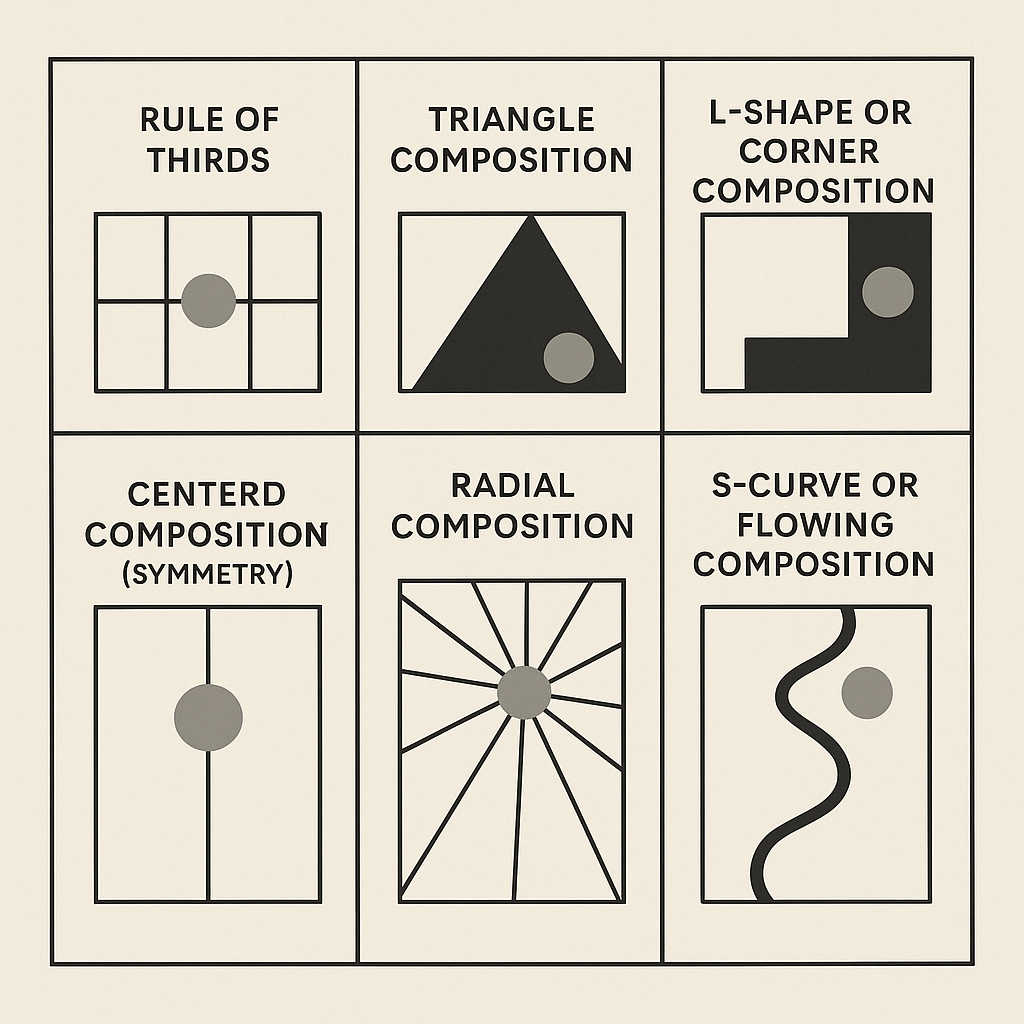
- Rule of Thirds: Imagine your canvas divided into a grid with two vertical and two horizontal lines. Place important elements along these lines or where they intersect. Why it works: It creates balance without being too symmetrical, and gives your piece breathing room.
- Triangle Composition: Arrange your elements to form a triangle or pyramid shape. Can be symmetrical or dynamic (with one side longer or tilted). Why it works: Our eyes naturally follow triangular paths—it feels solid, grounded, and classical.
- L-Shape or Corner Composition: One side or corner holds most of the visual weight, like a tree on the left or a dark shape at the bottom. Why it works: It guides the viewer’s eye into the scene and creates a sense of space.
- L-Shape or Corner Composition: One side or corner holds most of the visual weight, like a tree on the left or a dark shape at the bottom.Why it works: It guides the viewer’s eye into the scene and creates a sense of space.
- Radial Composition: Elements radiate out from a central point, like petals on a flower or a sunburst. Why it works: It draws the eye inward or outward, creating a sense of energy and motion.
- S-Curve or Flowing Composition: A winding path through the composition—like a river, a body, or a swirl of smoke. Why it works: It’s dynamic and natural. Leads the eye gracefully through the piece.
- Frame Within a Frame: Use natural elements (like a window, arch, or tree branches) to frame your subject. Why it works: It adds depth and pulls focus to your main element.
How to Start Creating
You don’t need a fancy sketchbook or the “perfect” idea. Here’s how to begin: Start small. A doodle. A color swatch. A messy page of lines. Use what you have. Printer paper and a pencil? Perfect. Give yourself permission to make “bad” art. Seriously. It’s the only way to get to the good stuff. Try an art journal. Think of it as your creative playground—no rules, no judgment.
How to Practice (Without Burning Out)
Practicing doesn’t have to be rigid or boring. It can actually be fun and freeing.
- Pick a theme for the week. (Shadows? Plants? Just circles?)
- Set a timer for 10–15 minutes and draw whatever comes to mind.
- Challenge yourself. Try “Draw This In Your Style” or create a piece using only one color.
- Make bad art on purpose. It’s weirdly freeing—and you might stumble onto something amazing.
Explore and Stay Curious
Great art doesn’t come from talent alone—it comes from observation, research, and curiosity.
- Take walks. Look at how light hits a leaf.
- Collect art that speaks to you—on Pinterest, in magazines, in museums.
- Ask yourself: Why do I love this piece? Is it the color palette? The feeling? The story?
- Inspiration isn’t a lightning bolt—it’s a slow gathering of things you care about.
You’re Already an Artist
If you’re reading this, if you’re even thinking about making art—you’re already an artist. Your style, your voice, your journey—it all matters. So start now. Start gently. Start with something small. You don’t have to be great to begin. But you do have to begin to be great.
Shop EcoBound Art Supplies:
Discover our handmade, eco-friendly art supplies designed to inspire your creativity while caring for the planet. Click below to explore the shop!





 EcoBound Earth Blog
Leave a comment